



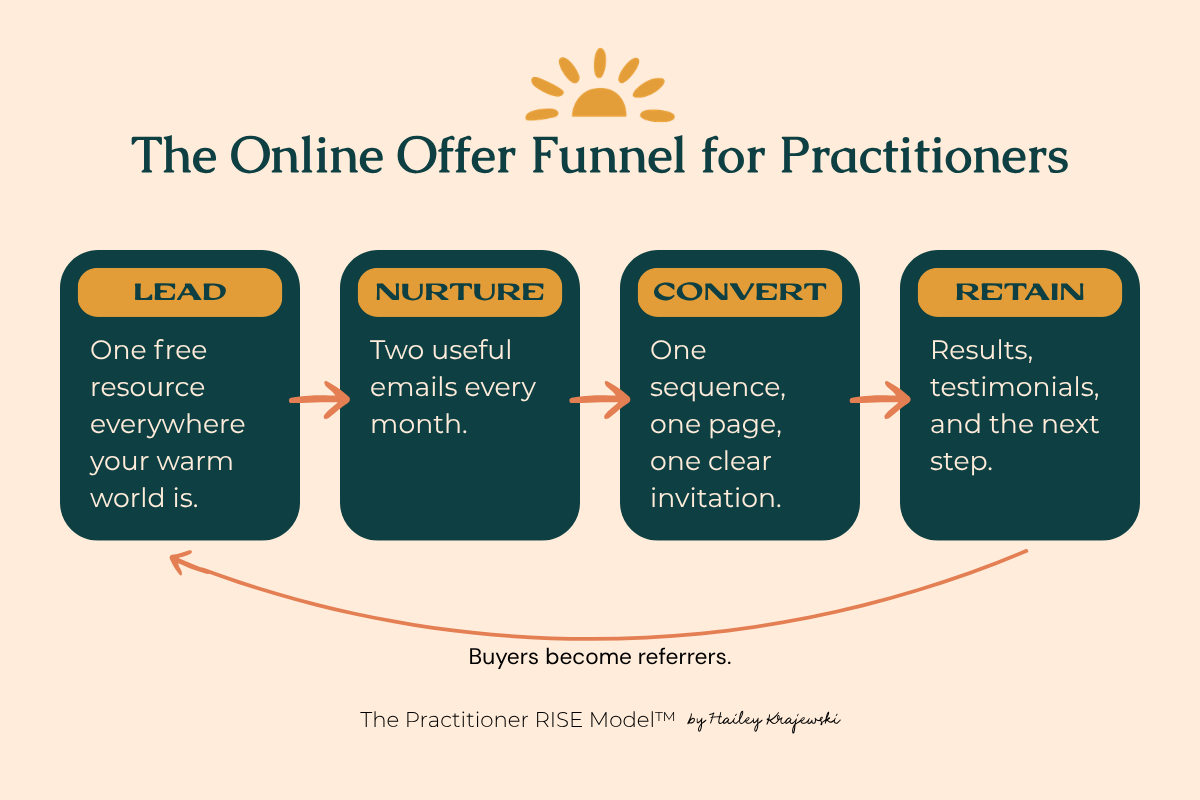
Marketing an online offer as a health practitioner comes down to four connected stages: Lead (a free resource that captures interested people onto your email list), Nurture (consistent, useful emails that keep the relationship warm), Convert (a clear launch sequence and sales page that invite people in), and Retain (delivery and follow-up that turn buyers into repeat clients and referrers). You don’t need ads, daily social media, or a marketing team to run this. You need each stage built once, working together, and pointed at one specific person, because your warm audience converts at the benchmark of 1 to 3 percent when the system exists and the message is clear.
Why practitioner marketing feels harder than it is
Most practitioners experience marketing as a pile of disconnected tactics: post more, start a newsletter, maybe run ads, try reels. Each tactic gets attempted in isolation, produces little, and confirms the suspicion that marketing “doesn’t work for my field.” The problem is rarely the tactics. The problem is that tactics without a funnel have nowhere to send people. A great post that leads to no list captures nothing; a list that never hears from you goes cold; a launch to a cold list lands flat. Marketing works when the stages connect.
This is the INTEGRATE and STAND OUT territory of The Practitioner RISE Model™, created by Hailey Krajewski. On the R.I.S.E. Pathway, ROOT gives you the message; INTEGRATE builds the funnel stages; STAND OUT grows the audience flowing into it; EXPAND is what becomes possible once the machine runs without you. This post maps the whole funnel; each stage also has its own full walkthrough post linked below. For the framework itself, see: What Is The Practitioners RISE Model™.
Stage 1: LEAD. Capture the attention you already generate
Your practice creates attention every week: patients, their families, website visitors, followers. The Lead stage gives that attention somewhere to go besides “book or leave.” One specific lead magnet (a guide, checklist, or private audio answering a question your ideal person is already asking), placed at every point of contact: your website’s “not ready to book yet” path, treatment room conversations, social bios, and personal follow-ups with past attendees.
Stage 2: NURTURE. Keep the list warm between launches
Email at least twice a month with something genuinely useful, rotating three types: teach (answer a real patient question in their words), connect (one true story from your story bank), invite (one clear next step). This stage decides launch outcomes months in advance, because a nurtured list converts at the top of the warm range and a silent list at the bottom.
Stage 3: CONVERT. Invite clearly when the offer opens
Conversion runs on two assets: a five-to-seven email launch sequence (problem, perspective, story, doors open, objections, purpose, invitation) and a sales page built on seven elements, opening with the transformation in your person’s own words. No pressure tactics required: state real constraints honestly, include a plain price, and make a direct ask. Warm audiences convert at 1 to 3 percent to a genuine, personal invitation.
Stage 4: RETAIN. Turn buyers into your next launch
Retention is the stage practitioners skip and the one that compounds. Deliver well, collect the transformation stories, invite testimonials, and give graduates a next step: the next cohort, a deeper offer, or simply staying on the nurture list as your warmest referrers. Every launch after the first gets easier because Retain feeds Lead: happy buyers bring their sisters, their colleagues, and their group chats.
The whole system, run by one person
Written out, four stages can sound like a marketing department. In practice, it is one lead magnet, two emails a month, one launch sequence reused each time doors open, and one sales page refined between rounds. Built once, maintained in a few hours a month, and improved with each cycle. This is the marketing engine behind every client story I share, including the practitioner whose program sold out from a single aligned email sequence with no ads, and it is how my own six-figure business runs on a maximum of 25 hours a week with Fridays off. The engine does the reaching; you keep practicing.
One caution from watching dozens of practitioners build this: the stages fail when you attempt them out of order or without ROOT. A launch sequence written before the message is clear converts poorly and teaches the wrong lesson (“online doesn’t work for me”). Maybe you’ve tried a piece of this before and concluded exactly that; the usual culprit is a missing stage, not a broken one.
FAQ
What is the best marketing strategy for a health practitioner selling online? A four-stage funnel: a lead magnet capturing warm attention, consistent nurture emails, a clear launch sequence with a sales page, and retention that turns buyers into referrers. Warm-audience marketing outperforms ads and daily posting for practitioner offers.
Do I need social media to market an online program? No. Social helps the Lead stage by pointing people to your list, and the funnel runs on email plus personal invitations. Many practitioner launches succeed with minimal or no social presence.
How much time does marketing an online offer take each week? Once built, a few hours a month: two emails, occasional lead magnet promotion, and launch weeks a few times a year. The build itself is a set of one-time projects, each covered in the linked posts.
Should I market my online offer to my existing patients? Yes, with an invitation rather than pressure. Patients are your warmest audience and often the people who asked for something like this. Mention it as a resource and let them decide.
What comes first: the offer or the marketing? The message comes first, then a validated offer, then the funnel around it. Marketing an unvalidated offer wastes the launch; the R.I.S.E. order (ROOT before INTEGRATE) prevents exactly that.
How do I know if my marketing is working? Watch one number per stage: list growth (Lead), reply and open activity (Nurture), launch conversion against the 1 to 3 percent warm benchmark (Convert), and repeat or referral buyers (Retain). One weak number tells you which stage to fix.
Key Takeaways
-
Practitioner marketing is four connected stages: Lead, Nurture, Convert, Retain. Tactics fail in isolation; the funnel works as a system.
-
The whole engine is one lead magnet, two emails a month, one reusable launch sequence, and one sales page.
-
Warm audiences convert at 1 to 3 percent to a genuine invitation; the nurture stage decides which end of that range you land on.
-
Retain feeds Lead: delivered results and testimonials make every launch after the first easier.
-
Build in R.I.S.E. order. A funnel without ROOT-stage message clarity converts poorly and teaches the wrong lesson.
Build it with people who get your world
Framework-level work like this is exactly what happens inside The Practitioner RISE Mastermind™: a guided space where Natural Health & Wellness Practitioners build the message, the funnel, and the offer together, in the right order, with support from people who understand both the healing world and the business.
Doors are open now: Join The Practitioner RISE Mastermind™
Or start by putting a number on what your funnel could carry: The Practitioner Expansion Audit™
Prefer to talk it through? Book Your Free Expansion Call!
—
Hailey Krajewski is a Sustainable Growth Advisor to Health & Wellness Practice Owners and founder of The Practitioner RISE Model™. She helps chiropractors, acupuncturists, naturopaths, and integrative clinic owners expand online beyond the treatment room without the grind, using the R.I.S.E. Pathway: ROOT, INTEGRATE, STAND OUT, EXPAND.
Pin
Leave a Reply
6 Ways To Start Your Morning Off Right
Mind + Body

Chia Seed Recipes For Keto
NUTRITION

My Morning Matcha Recipe [Bonus Recipes]
nutrition

How I Changed My Entire Life in 365 Days
Motivation

5 Signs You Should Break Up With Social Media
Mind + Body

Mind + Body
How I Detoxed in Just 3 Days [Exact Steps]


