Your Body Grew a Human: Prenatal Yoga, the Fourth Trimester, and the Truth About Bouncing Back
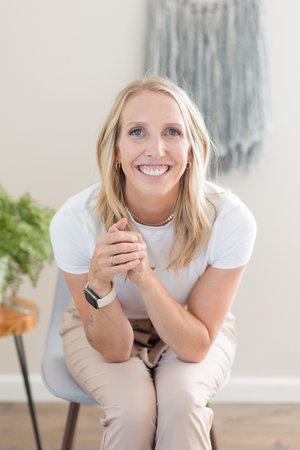
Mary Anne Tillotson had a hysterectomy at 31. She has never given birth. And by her own account, she's probably the least likely person to have built her career walking women through pregnancy and birth, until a friend asked her to be her yoga teacher and something clicked into place. Today, Mary Anne is a registered prenatal yoga teacher, NASM-certified personal trainer, and certified life coach who has guided hundreds of women through pregnancy, labor, and the disorienting first months of motherhood, without ever having lived it herself.
How Do You Become a Prenatal Yoga Teacher Without Ever Giving Birth?
Mary Anne built her prenatal yoga practice entirely through research, not personal experience, and it started with fear, not confidence.
Motherhood was never a given for Mary Anne. She always assumed she'd have kids eventually, but when she met her husband, he came with two sons, now 13 and 15, and she became a stepmom instead. Then in 2024, after years of unexplained symptoms, she was diagnosed with endometriosis. Mary Anne says her own diagnosis journey took years, in line with what she describes as a common pattern of women going undiagnosed for a long stretch before anyone identifies endometriosis as the cause.
Faced with the choice between a hysterectomy, a birth control implant, or continuing to manage her symptoms indefinitely, she chose the hysterectomy for her mental health, closing the door on biological motherhood in the process.
At the same time, she'd been quietly falling in love with yoga, going through teacher training in 2019 "just for fun" and graduating at the height of the pandemic. Prenatal yoga wasn't on her radar until 2021, when a friend asked her directly to be her prenatal teacher through pregnancy. Mary Anne describes her reaction bluntly:
"I was terrified. I knew nothing. I was like, how can I teach something that I've never experienced?"
Rather than turn the request down, she went all in on research, reading, studying, and asking her friend detailed questions about how her body felt day to day so she could adapt safely around real symptoms rather than textbook ones. That one relationship reshaped her entire teaching focus, and prenatal yoga became, in her words, her baby.
What Do Parents Spend Too Much Time Worrying About During Pregnancy?
Mary Anne says the biggest energy drain during pregnancy is "the stuff": registries, nursery themes, maternity wardrobes, and gear, and it pulls attention away from the parents themselves.
She's watched expecting parents get swept into pressure from every direction: what their mother-in-law expects on the registry, what a $300 product promises to fix, what the nursery is supposed to look like. In her view, all of that noise crowds out something more important: the actual season of change happening in a parent's body and identity. Families get so focused on acquiring the right gear that they miss the chance to prepare themselves for the life shift that's coming.
"It really seems like everybody gets so caught up in that stuff and they miss their season. They miss that season themselves."
Her advice isn't to skip the essentials, but to notice when registry pressure starts to replace actual preparation, mental, emotional, and relational, for the arrival of a baby who, she points out, will be a fully individual person from day one.
Why Does Mary Anne Push Back on "Bouncing Back" in the Fourth Trimester?
Mary Anne rejects the phrase "bouncing back" outright. She argues the body and identity are permanently changed by pregnancy and birth, and expecting a return to a prior self sets parents up to feel like they're failing.
This is the part of the conversation where her own experience and her professional focus meet most directly. She describes watching students ask each other whether they'd packed makeup for hospital photos, worried about how they'd look right after giving birth. To Mary Anne, that pressure, reinforced by social media, ignores what happened: a body carried and delivered a human being, regardless of whether the birth was vaginal, C-section, medicated, or unmedicated. She points out that hormonal shifts from pregnancy don't resolve on any fixed timeline; the body works through them over months, sometimes longer, especially depending on breastfeeding or a subsequent pregnancy.
"You'll never become the person you were before kids. Your body will never be that body again because you carried a human."
Mary Anne connects this directly to postpartum identity loss. She describes new parents being pulled toward impossible standards: breastfeed perfectly, look the same as before, be available for every need, and argues no one can meet all of it at once, nor should they be expected to. Her recommendation isn't more willpower; it's community that can absorb some of the load so a parent can step away long enough to reconnect with whoever they are now.
What's the Best Way to Support a New Parent?
Mary Anne's advice is simple: stop asking "what do you need" and instead offer something specific and low-effort for the parent to accept.
Open-ended offers of help put the burden of planning back on an exhausted new parent. Mary Anne suggests concrete alternatives instead: dropping off a meal that reheats easily and texting ahead so no one has to host a visitor, gifting a laundry service or delivery app credit, or simply offering to hold the baby for a specific stretch of time so the parent can shower or nap. She notes that most of what drains new parents isn't the baby itself, but everything else that has to happen around the baby: dishes, other kids, meals, while someone is holding an infant.
"If you say, 'I can come and hold the baby so you can shower,' pick one and be okay with whatever it is that they ask for."
This philosophy extends into The Bump Collective, the North Carolina community she founded, which brings together a prenatal massage therapist, a lactation consultant, a pelvic floor physical therapist, and a doula alongside her own yoga teaching. The group runs periodic day retreats pairing pregnant women at similar stages with educational sessions and a vendor fair of birth-adjacent local businesses. Mary Anne describes the effect of finding even one resource in this space as a ripple: connecting with one trusted professional tends to lead to a wider network.
What Is the Book "Space, Strength, Balance, Breath" About?
Mary Anne's upcoming book is built around four pillars: space, strength, balance, and breath, and is designed to make prenatal yoga physically and financially accessible to women who don't have a local class option.
The project grew out of a specific frustration: a pregnant friend and photography collaborator, Megan Easter Day of Easter Day Creative, kept texting Mary Anne in pain, looking for guidance she couldn't always give fast enough. That gap, women without access to a prenatal-specific class, sometimes without access to yoga at all, became the reason for the book.
Each of the four sections addresses something distinct: creating space in the body as pregnancy progresses (rather than chasing flexibility, since pregnancy hormones can create a false sense of it), building physical strength for labor and delivery, balancing the psychological weight of a changing family and identity, and using breath as a tool through pregnancy, delivery, and pelvic floor recovery.
Mary Anne is especially focused on representation: her models are pregnant women at varying stages and body types, rather than a single idealized frame.
"I want you to feel empowered and educated and powerful going into your birth and into motherhood."
Quick Answers
Is prenatal yoga safe if I've never done yoga before?
Mary Anne's approach is built around adapting to each person's specific body and symptoms rather than assuming a general fitness background, which is part of why she's writing a book aimed at people without local access to prenatal-specific classes.
How long does it take to feel "normal" again after birth?
Mary Anne says there's no fixed timeline. Hormonal and physical recovery is a gradual process that can extend well beyond the first year, and she pushes back on any framing that suggests parents should "bounce back" quickly.
What's the best way to help a new parent without overstepping?
Offer one specific, low-effort task: a ready-to-reheat meal, a laundry gift card, or holding the baby for a set amount of time, rather than asking an open-ended "how can I help?"
About Mary Anne Tillotson
Mary Anne Tillotson is a registered prenatal yoga teacher, NASM-certified personal trainer, and certified life coach based in Belmont, North Carolina. She founded The Bump Collective, a local network of birth and postpartum professionals, and teaches a weekly prenatal yoga class at Belmont Yoga. Her book, Space, Strength, Balance, Breath: A Prenatal Yoga Pathway, releases Black Friday 2026.
Instagram: @thebumpcollective and @queenbeecoach
Website: thebumpcollectivenc.com
Get on the waitlist for her book HERE.
The Bump Collective's next day retreat: Saturday, August 1st, in Belmont, NC
This episode is for educational purposes and isn't a substitute for individualized medical advice.