Why Your Baby Won't Sleep Unless You're Holding Them, and Why That's Normal
Listen Now! Apple | Spotify | YouTube
When Laura Longanecker's first daughter was born, she thought her nursing background and the research she'd already done meant she was prepared. Then the birth was traumatic, the hospital sent her home with a warning she couldn't shake, and her newborn wouldn't be put down for more than twenty minutes at a time. What she decided to do that first week changed how she's practiced ever since.
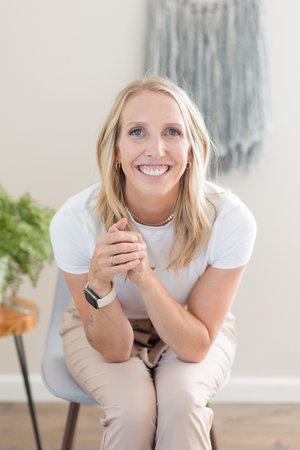
On this episode of the Practitioners Rise Podcast, host Hailey Krajewski talks with Laura Longanecker, RN and certified baby-led sleep & wellbeing specialist, about why so many babies won't sleep unless held, and what that says about their biology rather than their parents.
Why won’t my baby sleep unless i’m holding them?
Because human babies are what Laura calls "carrier mammals," not "nesting mammals" like rabbits or deer, so their bodies expect near-constant physical contact with a caregiver rather than independent sleep in a crib across the room. Wanting to be held isn't a behavior problem to fix; it's exactly how they're built to survive.
Laura draws the comparison from her own research into infant biology. Nesting mammals feed their young and then leave them for hours at a time, which works because their milk is dense enough to hold a baby over. Human milk is different. It's high in carbohydrates but comparatively low in the fat and protein that would sustain a baby through long stretches alone, which means human infants are built to nurse on demand, in close contact, not on a schedule from another room.
There's a developmental piece too. Laura describes the newborn period as a kind of second gestation happening outside the womb, a stretch of extraordinary brain growth that depends on a baby staying physically close to a caregiver's breathing, temperature, and nervous system. She points to Greer Kirshenbaum, PhD, a neuroscientist and doula whose book The Nurture Revolution details how that early physical closeness shapes a child's brain development and future capacity to handle stress.
"They don't have a brake pedal system. They have a gas pedal where they can escalate, but they don't have a brake pedal."
That's why a baby can't be expected to calm themselves down the way an adult can. Laura also points to research from Dr. James McKenna, a Notre Dame researcher and author of Safe Infant Sleep, whose work suggests the vast majority of parents worldwide would find questions like "should my baby sleep alone" unfamiliar altogether, since solitary infant sleep is largely a feature of wealthy, industrialized cultures rather than a biological default.
What's the Difference Between Sleep Training and a Gentle Sleep Transition?
Sleep training, in Laura's view, is any formula-based method with a fixed set of steps a baby is expected to follow regardless of temperament or circumstance, while a gentle transition uses a caregiver's continued presence to help a baby move toward more independent sleep.
She's careful to separate this from boundary-setting, which she sees as a completely different, and necessary, part of parenting.
"Setting a loving boundary for your child and then accompanying them through the corresponding emotion that comes with that is not sleep training."
In practice, Laura says this might look like continuing to hold and comfort a baby while gradually introducing other soothing methods alongside nursing, so that a later change doesn't strip away nervous-system regulation all at once. She also weighs timing carefully. A baby in the middle of a major developmental leap, like learning to crawl or walk, generally isn't in a good window for a big change to their sleep routine, regardless of the approach.
What Does "Informed Consent" Mean When a Provider Recommends Sleep Training?
Laura, who spent years working as a registered nurse before founding Strawberry Moon Sleep, applies the same informed-consent standard used for any medical intervention, weighing risks, benefits, and alternatives against a specific child, to sleep training recommendations she considers a behavioral intervention that's often handed to parents without that context.
"A pediatric specialist gets an average of two hours of sleep education in their entire medical training, and some reported none."
That's Laura's own account from her research into medical training, not a claim she's citing to a specific published study, and it's worth hearing in that light. Her larger point is that most providers aren't asking about a family's feeding goals, a child's temperament, or whether an underlying issue might be driving the wakefulness before recommending a method. Because parents often don't know which questions to ask, Laura built a free sleep training informed consent conversation guide, available on her website, with prompts like what specific method is being recommended, what evidence supports it, and how it might affect breastfeeding goals.
What's Really Behind a Baby Who Won't Stop Waking Up?
Before treating frequent waking as something to sleep-train away, Laura looks for a physical or developmental root cause, since a formulaic intervention doesn't resolve an underlying issue it was never designed to address.
Iron is one of the first things she checks for after a family has already been told their baby's levels are "normal."
"You can have a normal hemoglobin that's within normal limits, and your ferritin can be absolutely in the toilet."
Ferritin, not hemoglobin, reflects how much iron is stored and available for use, and Laura says it's often the piece left unchecked at well-child visits. She also looks at airway issues like mouth breathing or snoring, which parents aren't always told to flag as unusual, along with developmental leaps and, in some cases, the days following a medical appointment. Temperament matters just as much. Laura describes some babies as naturally easygoing and others, like her own first daughter, as slower to warm up to change, which means the same approach won't fit every child.
Just as often, Laura says there's nothing to fix. Sometimes the answer is that a baby waking twice a night is a normal baby, and the more useful conversation is about giving the parent tools and support to get through it, since her approach treats a mother's rest and well-being as inseparable from her baby's.
Quick Answers
Is it normal for a baby to not want to be put down? Yes. Laura explains that human infants are "carrier mammals" whose biology expects near-constant physical contact with a caregiver, so resisting independent sleep is a sign of normal development, not a problem to fix.
What's the difference between sleep training and a gentle sleep transition? Sleep training follows a fixed, formula-based set of steps regardless of the baby. A gentle transition keeps a caregiver present and responsive while gradually introducing change.
What should I ask before sleep training my baby? Laura recommends asking which specific method is being recommended, what evidence supports it, how it accounts for your child's temperament and medical history, and how it might affect feeding goals.
Can low iron affect a baby's sleep? Laura says it can, and that ferritin, the marker for stored iron, is often not checked even when a standard hemoglobin test comes back normal.
Is bed-sharing safe? Laura's approach is grounded in Dr. James McKenna's research on safe co-sleeping practices, but safety depends on following specific guidelines. Talk with your pediatrician about what's right for your family.
This episode reflects Laura's clinical background and personal research. It's shared for educational purposes and isn't a substitute for individualized medical advice from your child's pediatrician.
About Laura Longanecker
Laura Longanecker is a registered nurse, mother of two, and certified baby-led sleep & wellbeing specialist. She's the founder of Strawberry Moon Sleep, where she helps families get more rest while staying responsive to their children's needs and their own instincts.
Connect with Laura:
Website: strawberrymoonsleep.com
Instagram & Facebook: @StrawberryMoonSleep
If today's episode resonated, download Laura's free Sleep Training Informed Consent Conversation Guide on her website, and share it with someone .