Should I Create an Online Course, a Membership, or a Group Program?
Short answer: all three work, and the right one depends on the shape of your expertise.
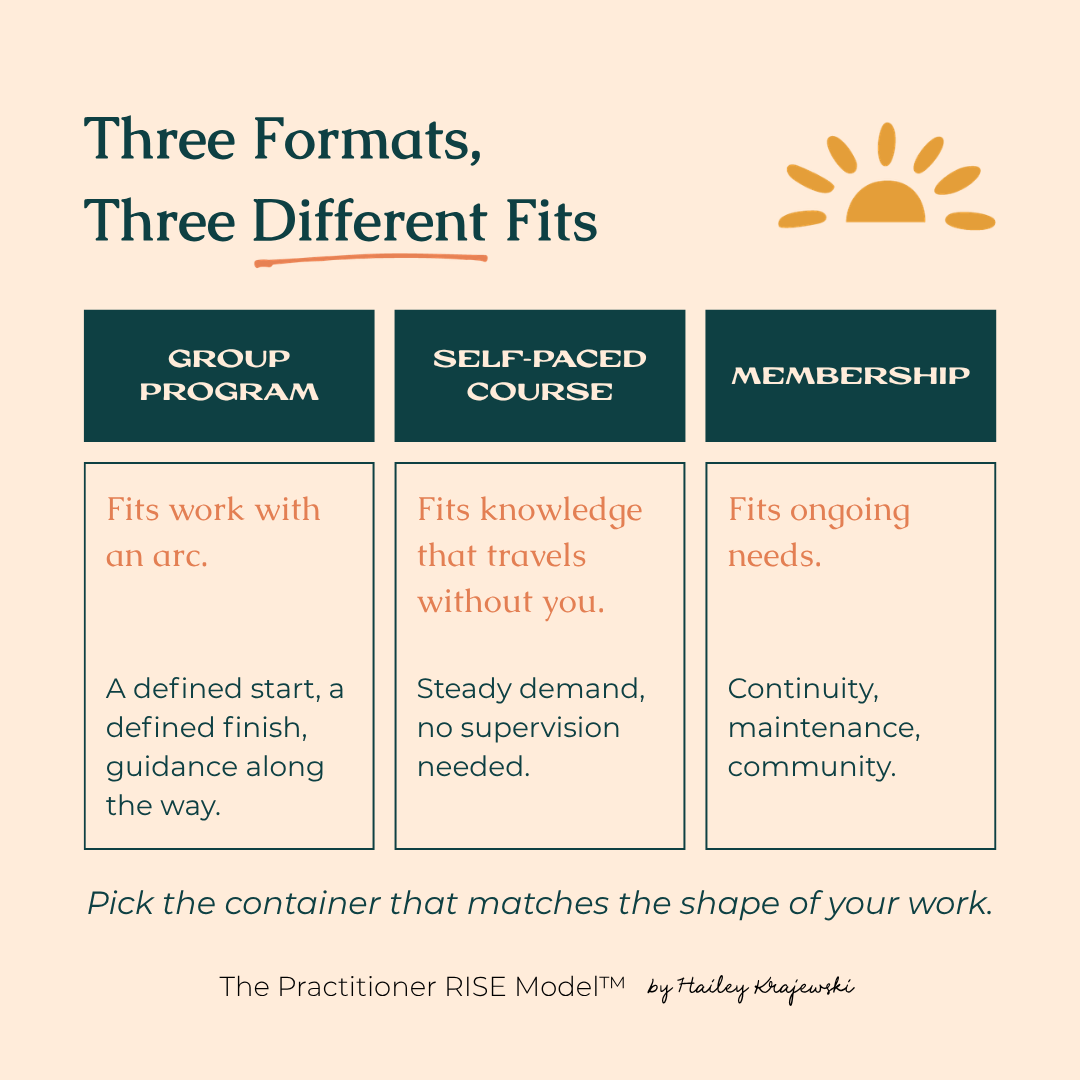
A group program fits when your work moves someone through a defined transformation.
A self-paced course fits when the material stands on its own, and demand is steady year-round.
A membership fits when the need is ongoing, and people want continuity rather than a finish line.
There's one thing worth knowing before you choose, because it shapes how you build whichever one you pick. Information used to be the product. Anyone can get a reasonable answer to most health questions in seconds now, so what people pay for has shifted toward guidance, structure, and not being alone with the material. The good news for your schedule: it has less to do with your availability than it sounds.
What changed, and what it means for your time
For about a decade, the advice was to record a course once and sell it forever. The economics looked beautiful, but the completion rates did not.
Self-paced courses average somewhere between 10 and 20 percent completion. Cohort-based programs, where people move through together on a schedule, report completion in the 85 to 96 percent range. Ruzuku's 2026 platform data found that courses with active community features (discussion threads, peer feedback, group activity) hit 65.5 percent completion, compared with 42.6 percent for courses without them.
Completion is important because it produces the testimonials, referrals, and repeat buyers that let you sell the next thing. A course nobody finishes likely won’t give you the social proof.
Here's the part that gets misread. What lifts those numbers is people having structure, deadlines, peers, and somewhere to ask questions. Your constant availability is one way to provide that, and it's the most expensive way. Peer community does a lot of it without you in the room. So does a clear start date, a defined window, or a weekly prompt that lands in someone's inbox on its own.
You can build something that runs mostly without you and still have it work.
Why practitioners get stuck here
Course, membership, group program, workshop, digital product: the options multiply until choosing feels like a permanent identity decision, and the project sits untouched.
Some of that pressure comes from treating this as a ranking question, where one format is the right answer and the others are lesser versions of it. These are three delivery containers suited to three different shapes of work.
That's the kind of decision The Practitioner RISE Model™ places in the INTEGRATE stage: made after ROOT has settled who you serve and what you promise them. Format is a delivery question, and delivery questions get easier once the promise is clear.
Before any of it, though, settle whether people want the topic at all. Delivering the wrong topic beautifully still doesn't sell. If you haven't confirmed demand yet, start there: How Does a Wellness Clinic Owner Create Online Income Beyond the Clinic? covers how to validate through real conversations before you build anything.
Which format fits which kind of expertise
A group program fits when the work has an arc.
Some expertise moves people from one state to another over a defined stretch: a protocol, a reset, a recovery pathway, a phased plan. If you can name where someone starts and where they finish, that shape maps cleanly onto a cohort with a start and end date.
Group programs also suit work where results depend on adjustment along the way. If people need to be seen, questioned, and course-corrected to get the outcome, live delivery is doing real work.
This is also the format the market data currently favors most: highest completion, highest prices, strongest proof for what you build next.
Best fit: transformation with a defined start and finish, results that need real-time guidance, a topic you're still refining.
What it asks of you: scheduled live time inside a defined window (even if it’s once a month).
Watch for: the calendar. Cohort windows keep it contained instead of open-ended.
A self-paced course fits when the knowledge travels without you.
Some expertise is complete once it's explained well. Someone can take it, apply it, and get the result without checking back in. Reference material, preparation content, and protocols people follow on their own sit here.
This format also fits when demand is steady and spread out. If people need your material at different moments rather than all at once, waiting for the next cohort is friction that costs you sales.
Given the completion data, it's worth adding something so people aren't working through it entirely alone. That can be small. One live Q&A a month, a discussion thread people answer for each other, or a drip schedule that paces the material instead of dumping it all at once. A single monthly call is a couple of hours of your time and moves a course meaningfully closer to the completion rates that produce testimonials.
This could even work for you as an add-on for your practice members since you’re already likely seeing them on a recurring schedule, a self-paced course or membership, which we’ll get to next, may work really well for you.
Worth being straight about the tradeoff: a course with one monthly touchpoint won't complete at the rate of a full live cohort. It will do considerably better than a course with nothing, and it costs you a fraction of the time.
A membership fits when the need is ongoing rather than finished.
Some care doesn't have a finish line. Chronic condition management, maintenance and prevention, seasonal protocols, and practitioner communities are continuous by nature. If your patients cycle back for support rather than graduating, a membership matches how your work already behaves.
This fits where integrative health is heading. The industry is moving toward continuous, preventive care supported by virtual check-ins, and wellness itself is becoming more communal, with group-based experiences replacing solo pursuits.
The shape that's working is small and high-touch, though high-touch doesn't have to mean high-hours. Creators are capping membership size on purpose to protect the experience, charging more for a higher level of service rather than chasing member count. A community of 50 to 100 people at $20 to $50 a month produces roughly $1,000 to $5,000 monthly, and margins stay strong once setup costs are covered.
A membership can run largely on its own: a monthly resource drop you batch ahead of time, a seasonal protocol released on a schedule, a space where members answer each other.
Add one live call a month, and you have the human anchor without a standing weekly commitment. Some practitioners do a single 60-minute group Q&A, and nothing else live all month.
Best fit: ongoing needs, an existing audience or graduate group, work that's naturally seasonal or cyclical.
What it asks of you: consistent value arriving on a rhythm, which you can batch, plus a light live anchor if you want one.
Watch for: retention is the whole model. A small engaged group beats a large disengaged one, every time.
Four questions that break the tie
If more than one format fits your expertise, run your situation through these:
What does your audience already ask for? If patients keep asking the same question, or colleagues keep asking how you did something, that's demand you didn't have to create. This is the heaviest filter, because a format you can sell beats a format that scores well on paper.
How much do you already have built? Recorded material or a taught curriculum pushes you toward the course. Starting from nothing but expertise pushes you toward live delivery, where you build as you teach.
What could you still be delivering in six months without dreading it? Be honest about live calls, video, and ongoing community presence. Those are the parts people underestimate, and the offer you resent maintaining doesn't survive long enough to matter.
What's the revenue-to-time ratio? Programs concentrate delivery into a defined window. Courses front-load the work and earn afterward. Memberships spread the work out with no natural off-season. None is better in the abstract. They're better or worse against the schedule you're trying to protect.
Whichever one you pick, start smaller than feels impressive.
I once heard a quote from someone that I love. “Done is better than perfect, and perfect doesn’t mean profitable.”
The format decision is about fit. How you launch is a separate question, and the answer is the same across all three: a founding round, a pilot cohort, or a beta membership at a reduced rate.
You get paid while you find out what people need, and you build the rest from what they show you. That's what keeps a course from being built on guesses, and it applies as much to a membership as to a group program.
The formats aren't locked, either. A live program you record can become a course. A course with an active community can become a membership. That makes the first decision a starting point rather than a permanent structure.
What if you've already started building?
Many practitioners land on this question with a platform already paid for and part of a curriculum already recorded. That work isn't wasted, and it doesn't mean starting over.
Run a live round using what you've built. Teach it in real time to a small first group, use the modules you have as the backbone, and let the gaps fill in as you go. Your participants will show you what lands, what needs rework, and what you thought was essential but nobody needed.
You end up with a tested curriculum, real feedback, and testimonials. The half-built course becomes a head start.
FAQ
What's the difference between an online course and a group program? A course is pre-recorded and self-paced. A group program is delivered live to a cohort over a defined window. Courses suit material people can apply on their own. Programs suit outcomes that need guidance and adjustment along the way, and they complete at far higher rates.
Are online courses still worth creating in 2026? Yes. What's changed is that content alone completes poorly, since the information is available free and instantly elsewhere. Courses that give people structure, a schedule, or somewhere to ask questions still perform well. That support can be light and mostly automated.
How do I add a human element without giving up my time? Most of what drives completion is structure and peers rather than your personal availability. Drip the content on a schedule instead of releasing it all at once, give people a place to answer each other, and add one live call a month if you want a personal anchor. A batched monthly session is a couple of hours, and it does most of the work of being present without a standing weekly commitment.
Can an online offer run without me being available all the time? Yes, and that's the point of building one. The version that fails is a folder of videos with no structure and nobody around it. The version that works gives people a rhythm, a community, and one predictable place to reach you, all of which you can design in advance and batch.
Is a membership a bad first offer? Not inherently. A membership is a poor fit when you have no audience yet and the need you're serving has a natural endpoint. It's a strong fit when your work is ongoing by nature, which describes a lot of integrative and preventive care, or when you already have graduates and followers asking to stay connected.
How many members do I need for a membership to be worth it? Smaller than most practitioners assume. Roughly 50 to 100 members at $20 to $50 a month produces about $1,000 to $5,000 monthly, and capping the size on purpose is a real strategy right now, since a small engaged group retains better and supports a higher price.
Which online offer format makes the most money for practitioners? Cohort-based group programs currently command the highest prices, with medians running several times higher than comparable self-paced courses. Courses earn longer with less ongoing delivery. Memberships compound if retention holds. Fit matters more than format, since the offer matched to your expertise will outperform the one that looks best on paper.
What if I hate being on video? Weight that heavily. Audio lessons, written modules, and live calls without cameras all work, and there are strong versions of all three formats that don't put you on camera. Energy fit is a real decision criterion here, not a soft one.
Can I offer more than one format? Eventually, and it works best when they connect. A program that graduates people into a membership, or a course that feeds a group offer, gives people a next step. Running two unrelated offers at once is where practitioners tend to get stretched thin.
Key Takeaways
All three formats work. The right one depends on the shape of your expertise, not on a ranking.
Information stopped being the product. People pay for structure, guidance, and not being alone with the material.
That doesn't mean being available constantly. Peers, deadlines, drip schedules, and one live call a month do most of the work, and you can batch it all.
Group programs fit transformations with an arc; courses fit knowledge that travels without you; memberships fit ongoing needs and existing audiences.
Cohort programs complete at 85 to 96 percent versus 10 to 20 percent for self-paced. Adding light structure and community to a course closes much of that gap.
Memberships work small: 50 to 100 people at $20 to $50 a month, with retention as the whole model.
Validate the topic first, then start smaller than feels impressive: a founding round, a pilot cohort, or a beta membership.
Put a number on it before you build anything
Whichever format fits, the audience math underneath is the same, and you can run it today. The Practitioner Expansion Audit™ walks you through it.
Then bring it to a free Expansion Call, and we can match the format to your practice together.
---
Hailey Krajewski is a Sustainable Growth Advisor to Health & Wellness Practice Owners and founder of The Practitioner RISE Model™. She helps chiropractors, acupuncturists, naturopaths, and integrative clinic owners expand online beyond the treatment room without the grind, using the R.I.S.E. Pathway: ROOT, INTEGRATE, STAND OUT, EXPAND.